
Providers declare they understand and adhere to the guidelines.
Buyers demonstrate due diligence.
IVOSA is a free public register of first-aid training providers. Each provider works through the relevant HSE, Ofsted and EYFS guidelines and declares that they understand and adhere to them. Buyers can see each provider's registration and policies, and ask for an independent audit.
I train first aiders
"I know the guidelines and I follow them. I've said so publicly, with my name on it, as a registered member of an independent industry body. My customers can book me knowing they've shown due diligence."Join the register, free →
I buy first-aid training
"It's my job to choose a provider with care. A provider on the IVOSA register has worked through every guideline that applies to their courses and declared they follow them. That doesn't guarantee quality. Nothing can. But it shows I took care, in a way I couldn't with a provider who isn't registered."Find a provider →
Regulated or not? HSE doesn't rank one route above another, and the syllabus is the same. See what's actually different →
What the register is, and isn't
- A public, signed declaration, renewed every year.
- Not an inspection of courses or instructors.
- Backed by a yearly audit of the facts on paper (planned).
For providers
What you get
- A public record that you know the guidelines and follow them, with your name on it.
- Membership of an independent, not-for-profit industry body, free.
- Something your customers can point to when they need to show due diligence.
- Free model policies, if you don't have your own.
You don't have to choose
If a customer wants a regulated qualification, keep your awarding-body membership and run that course through it. For everything else, deliver under IVOSA. You keep the same syllabus and instructors, pay no awarding-body fee, and have a public record your customer can check.
What joining involves
- Tell us which courses you run.
- Work through the HSE, Ofsted and EYFS guidelines that apply to them, in plain words.
- Declare, guideline by guideline, that you understand and follow each one.
- Where a guideline needs a policy, upload your own or adopt ours.
- A named person signs the declaration. You renew it every year, and re-confirm straight away if a guideline changes.
The audit
- By joining, you agree to one audit a year if a buyer pays for one. Any further audit in that year is only by your agreement.
- We look at three courses and check the facts on paper: instructor qualifications and annual skills checks, learner records, feedback, and the policies you declared.
- Pass, and you show AUDITED for 12 months. Small gaps get an amber mark until you fix them, within 8 weeks at most.
- Any fee you pay us covers our costs only.
Registration opens soon.
For buyers
"It's my job to choose a provider with care. A provider on the IVOSA register has worked through every guideline that applies to their courses and declared they follow them. That doesn't guarantee quality. Nothing can. But it shows I took care, in a way I couldn't with a provider who isn't registered."
Your responsibility
The EYFS framework for early years providers (July 2025) says: "Providers are responsible for identifying and selecting a competent training provider to deliver their PFA training." It also says: "There is no hierarchy in relation to the range of Training Providers who offer Paediatric First Aid training".
Not an invented category
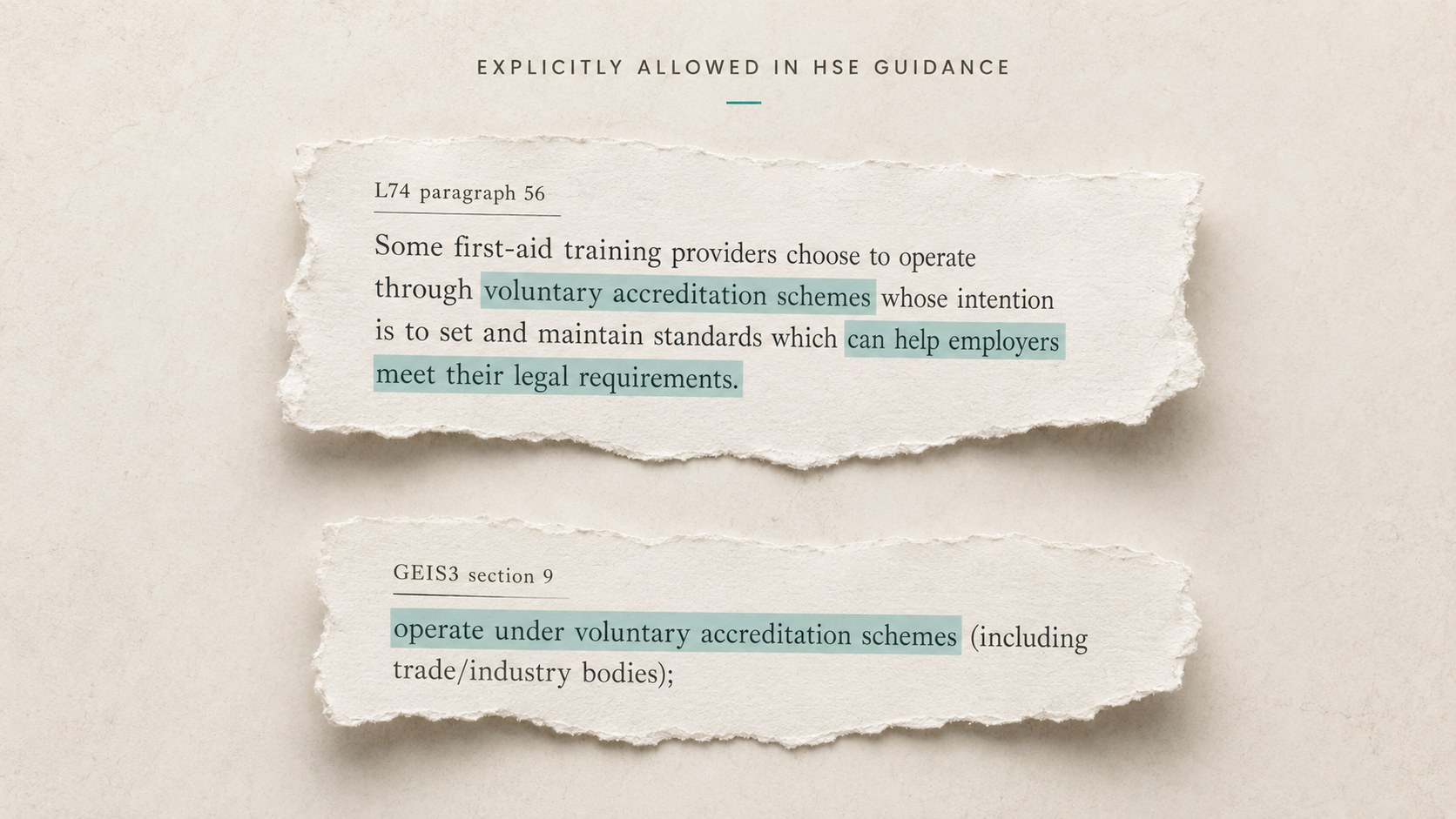
HSE guidance explicitly identifies what HSE calls “voluntary accreditation schemes”, including trade and industry bodies, as one route available to first-aid training providers — and explains that such schemes can help employers select providers and meet their own legal responsibilities.
These extracts describe such schemes generally. They do not constitute HSE approval or endorsement of IVOSA.
Regulated or not: what's actually different?
- The syllabus is the same. HSE and EYFS set the course content, whichever route a provider takes.
- Instructors need the same qualifications. The same first-aid and teaching qualifications apply on every route.
- Every instructor's skills are assessed at least once a year, on every route. HSE requires it.
- Neither HSE nor EYFS ranks one route above another. EYFS says there is "no hierarchy".
- Regulated courses go through an awarding body, which adds a fee to each certificate.
- We know of no published research showing regulated courses produce better first aiders.
How the register helps
IVOSA is a free public register of first-aid training providers. Each provider works through the relevant HSE, Ofsted and EYFS guidelines and declares that they understand and adhere to them. Buyers can see each provider's registration and policies, and ask for an independent audit.
What we can and can't promise
The register
- Every provider has worked through the guidelines for their courses and declared that they understand and follow them.
- A named person signs that declaration. It's renewed every year, and re-confirmed straight away when a guideline changes.
- If a complaint suggests a declaration is false, we look into it at our cost. Providers shown to have made a false declaration are removed.
- It is not a check. We have not inspected the provider, their courses or their instructors.
The audit (planned, not yet running)
- Any buyer can pay for an independent audit. Every provider on the register agrees to one a year.
- We look at three courses: yours, plus two picked at random.
- We confirm the facts on paper. Each instructor was qualified on the day and had their annual skills check. Learner records were kept. Feedback was collected. The provider holds the quality plan, complaints procedure and policies it declared.
- A provider that passes shows AUDITED for 12 months. There's no score or grade.
- Small gaps get an amber "Needs improvement" mark until they're fixed, within 8 weeks at most. Serious failures mean removal from the register.
What an audit can't do
- It can't judge how well a course was taught, or confirm how long it ran.
- It doesn't review teaching materials.
- It confirms that records exist and agree. It can't prove a course happened exactly as recorded.
What stays with you
- Choosing a provider that suits your people and your risks. The register helps you show you checked. It doesn't make the choice for you.
Independence
Why who pays matters
- When an organisation that approves training providers is paid by those same providers, through membership, centre or certificate fees, its income depends on keeping them approved.
- When that organisation is owned by shareholders, its profit does too.
- That is a conflict of interest, however well it is managed.
- IVOSA is built without it. Providers join free. Buyers pay for audits, at cost. We have no shareholders and take no profit.
- Keeping a provider on the register earns us nothing. Removing one costs us nothing.
The only fees a provider pays
The only fees a provider ever pays us are for a recheck after a failed audit, or to be reassessed after removal. These cover costs only. The checks are run by the system and signed off by a person, and removals are decided by our board.
More about who founded IVOSA, and how our board makes its decisions, will be added here.